
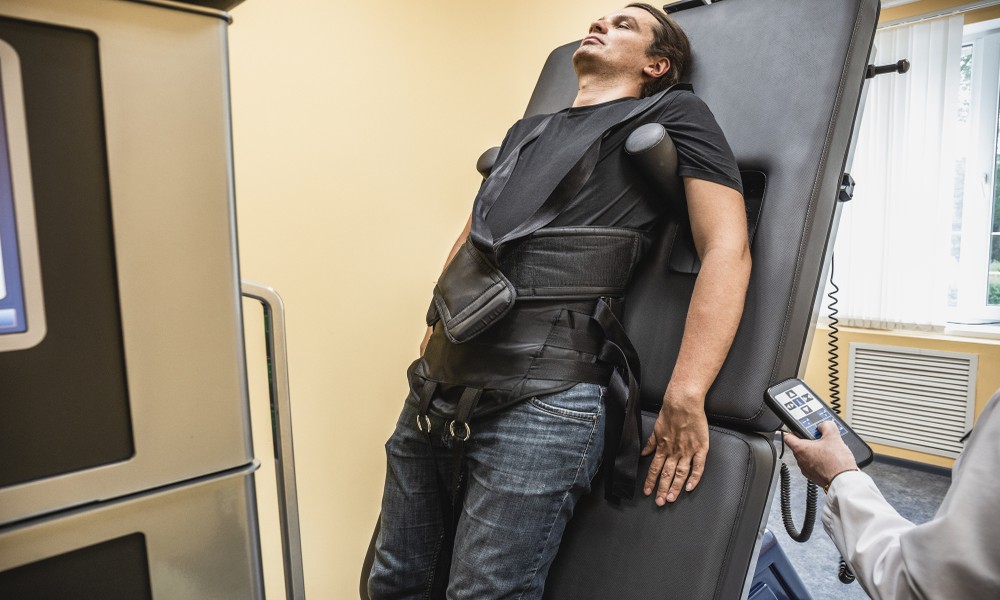
If you have been told you need surgery for a herniated disc, or you have been living on muscle relaxers and gabapentin for sciatica, there is a category of treatment that does not get explained well by either surgeons or general chiropractors. Non-surgical spinal decompression on the DRX9000 is a specific protocol, not a brand of stretching, and it works on a principle of physics that older traction methods cannot reproduce. Draper Spinal Care has used the DRX9000 Lumbar True Spinal Decompression machine for years with patients facing exactly this decision, and the technology earns the attention it gets.
The idea is straightforward. If you can lower the pressure inside a damaged disc far enough, the disc itself can begin to retract bulged or herniated material and pull water and nutrients back into its core. The hard part is generating that low pressure without triggering the muscles around the spine to clamp down and resist.
What Is Actually Happening Inside the Disc
A healthy lumbar disc has a tough outer ring called the annulus fibrosus and a gel-like center called the nucleus pulposus. The disc functions like a shock absorber, but it has no direct blood supply. It feeds itself through diffusion as the spine loads and unloads during normal movement. When the annulus tears or weakens, the nucleus can push outward (a bulge) or break through (a herniation), pressing on nerve roots and producing the leg pain, numbness, or weakness most people associate with sciatica.
Over years of compression from standing, sitting, and gravity, the disc loses height, dehydrates, and becomes less able to repair itself. The internal pressure of a damaged lumbar disc at rest is positive, often in the range of 75 to 100 mmHg. To pull material back in and rehydrate the disc, the internal pressure has to drop into the negative range.
The Physics of Negative Pressure
The DRX9000 is engineered to do one thing precisely: lower intradiscal pressure to the negative range, typically around minus 100 to minus 200 mmHg, while keeping the surrounding muscles relaxed. It does this through a computer-controlled cycle of pulling and releasing rather than a constant pull. The pull ramps up logarithmically over several seconds, holds, and then eases off before the body registers the stretch and recruits the paraspinal muscles to resist it.
That cycling matters more than most people realize. The reason older traction methods produce modest results is that the body fights a sustained pull. Muscles spasm, the patient tenses, and the force never reaches the disc itself. The DRX9000 protocol stays under the muscle guard reflex.
The angle of pull is also adjustable. A disc injury at L5 to S1 is treated at one angle, while a disc at L3 to L4 requires a different angle to apply force at the correct vertebral level. That precision is part of what separates targeted decompression from general lumbar traction.
Why It Is Not the Same as a Traction Table or Inversion Boots
Standard mechanical traction applies a steady linear pull that the body resists. Inversion tables use gravity to create a stretch, but they cannot target specific spinal levels, the load is not measured, and they are contraindicated for anyone with high blood pressure, glaucoma, certain cardiovascular conditions, or hernia. Neither approach generates the negative intradiscal pressure that allows herniated material to retract.
The DRX9000 was designed to bypass those limitations. It is not a stretching device. It is a controlled decompression system.
What a Session at Draper Spinal Care Feels Like
A treatment session lasts about 25 to 30 minutes. You lie fully clothed on a padded table with a harness around the lower chest and another around the pelvis. The computer is programmed for your specific disc level and a target pull force calibrated to your body weight and tolerance. The cycling begins gently, ramps up, holds, and releases on a repeating pattern. Most patients describe the sensation as a gentle, rhythmic pull, and many fall asleep during sessions. There is no pain during the session for the majority of properly selected patients.
The Typical Protocol
Most patients complete 20 to 25 sessions over six to eight weeks, often three sessions per week tapering down as the disc responds. The protocol is usually paired with cold therapy after each session to reduce inflammation, along with specific stabilization exercises to strengthen the deep muscles that protect the spine. Some patients respond noticeably in the first two weeks. Others take the full course before pain levels shift meaningfully. The disc itself needs time to retract and rehydrate, and that biology cannot be rushed.
Who Is and Isn’t a Candidate
Good candidates for DRX9000 decompression include patients with:
- Herniated or bulging lumbar discs with leg pain or sciatica
- Degenerative disc disease with chronic low back pain
- Facet joint syndrome
- Failed back surgery syndrome, in select cases
Poor candidates include patients with severe osteoporosis, spinal fractures, certain hardware fusions, spinal tumors, abdominal aortic aneurysm, pregnancy, or progressive neurological loss that needs immediate surgical attention. A thorough intake at the first visit, often with a review of your existing MRI, determines whether you fit the protocol.
Considering Decompression Before You Consider Surgery
Most disc surgeries are elective, which means there is usually time to try a non-surgical course before committing to an operation with real complications and a long recovery. If you have been told you need surgery, or you have been managing chronic disc pain with medication, schedule a consultation at Draper Spinal Care to find out whether the DRX9000 protocol is a reasonable fit. Bring your imaging, your prior treatment records, and your questions.
